

Ultrasonic Specifications
Senix ultrasonic sensors are nominally accurate at 69.8°F (20.5°C), and speed of sound at 343.63 meters (1,127.4 ft/sec).






Air is an elastic medium, meaning the speed of sound varies with temperature and humidity. Measurements conducted by ultrasonic sensors are affected by these variables.
ToughSonic® sensors use two methods to correct their measurements according to these environmental factors: built-in temperature compensation and external Reference Target Temperature Compensation (RTTC) accessories.
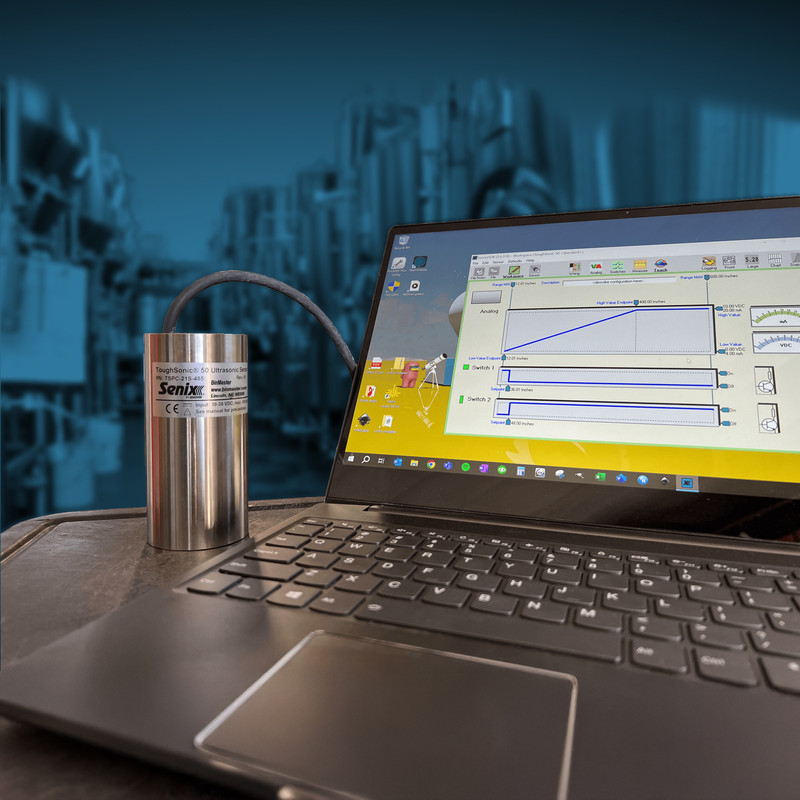
Senix ToughSonic sensors incorporate temperature compensation circuitry that can be enabled or disabled using SensorView™ ultrasonic configuration software.
Because of the wide variety of applications for distance and level measurement—as well as the possibility of dynamic environmental changes where precision is required—some testing is required during installation.
Temperature compensation within the sensor will accommodate sensor body temperature changes, but may not react quickly enough to shifts in the column of air through which the sensor is measuring.
This is particularly true where the sensor's mounting technique—such as in a stilling tube—provides thermal isolation from the ambient environment.
The speed of sound is nominally specified in dry air at 68°F (20°C) at 343 meters per second (1,125 ft./sec.) which equates to approximately 768 mph. However, it changes based on the environment.
Ultrasonic Specifications
Senix ultrasonic sensors are nominally accurate at 69.8°F (20.5°C), and speed of sound at 343.63 meters (1,127.4 ft/sec).

Sound of Speed & Temperature
The speed of sound changes about 1% for each 10°F shift in temperature, which must be considered in ultrasonic measurements.

How Speed of Sound Travels
As temperature drops, air becomes denser & sound travels faster. The faster sound travels, the shorter measured distances will appear.
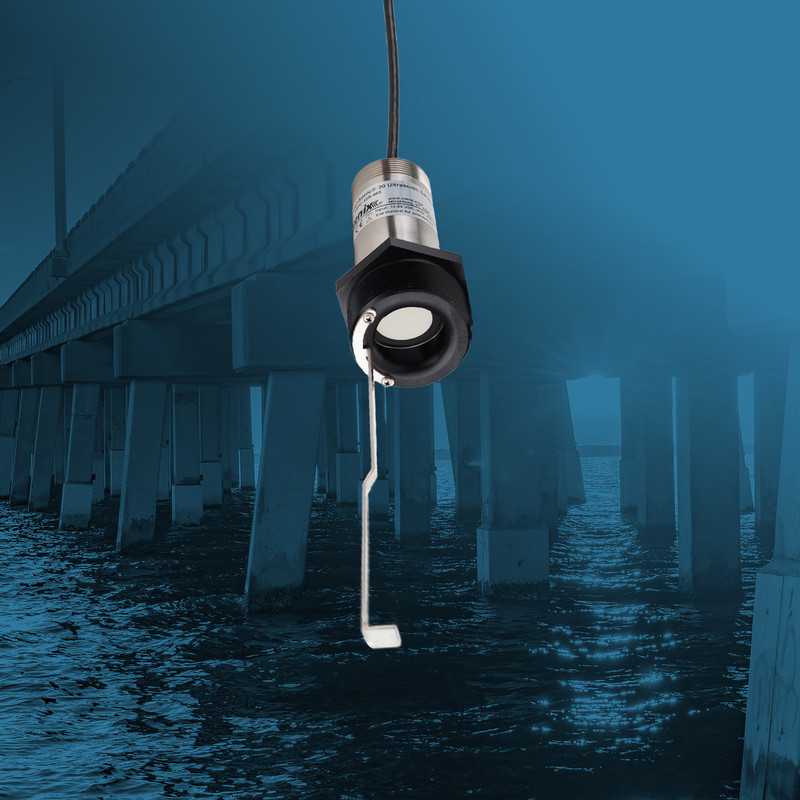
For cases where thermally generated errors are significant or measurement accuracy is required, Senix has implemented a Reference Target Temperature Compensation (RTTC) accessory.
So long as the air within the measurement path is uniform, variations due to temperature are substantially reduced.
This technique is particularly valuable where there may be rapid temperature shifts in the air.

Changes in humidity produce only a very slight shift in the speed of sound.
As the amount of water vapor increases in the gas mixture of the air, the mean molecular mass of the air decreases. This may seem counterintuitive, but consider that air is mostly nitrogen (molecular mass 28), while H₂O has a molecular mass of 18.
At 20°C, 1 atmosphere pressure, and 0% humidity, sound will travel at 343.36 meters per second.
Increasing humidity to 50% raises that to 343.99 m/sec, while 100% humidity raises it to 344.62 m/sec. Thus, the variation from 0% to 100% humidity is approximately 0.36% of measurement.
Because humidity changes are usually accompanied by temperature changes, they are partly accommodated by temperature compensation techniques.
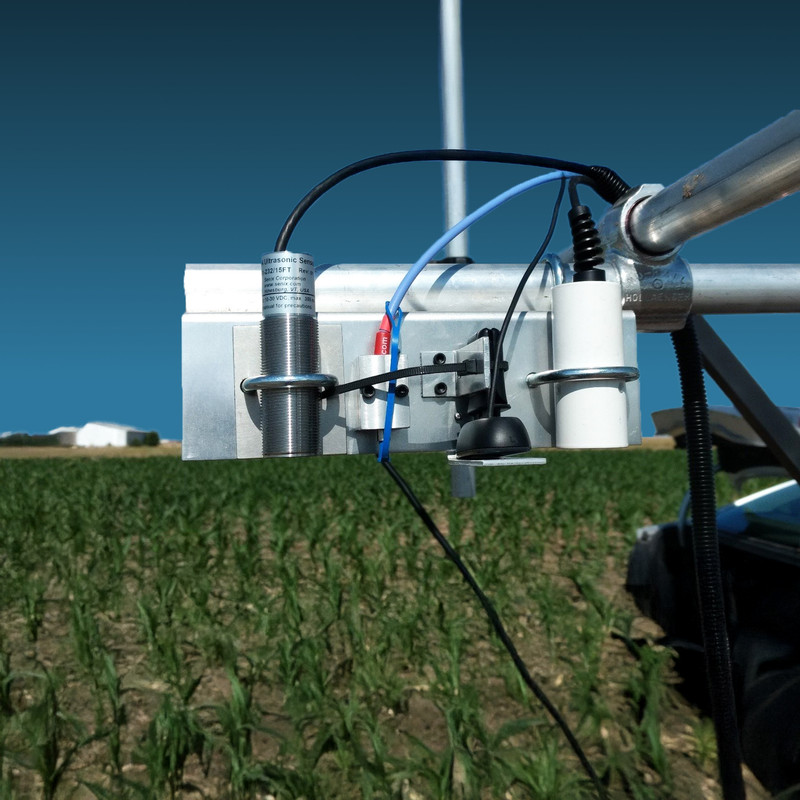
Measurement accuracy for Senix sensors are typically anticipated on the order of <0.2% of measured distance.
(Distinct from resolution, which is 0.086mm, or 0.00338”)
Note that we do not specify quarter percent accuracy due to the wide variety of environmental variables which might impact ultrasonic measurements.
SensorView software enables ToughSonic sensor users to:
The result is superior measurement performance over non-computer configurable models.